

In business environments, понуде represents structured offers that companies create to present value, pricing, or services to clients and partners. These offers shape how two parties begin a business relationship and how they move toward agreement.
In many cases, a ponuda includes pricing details, service descriptions, and delivery conditions. However, its meaning shifts depending on context. For instance, marketing teams use ponude for promotions, while B2B companies rely on them for formal pricing proposals. Therefore, understanding the definition of business offers and the nature of commercial offers is essential for interpreting how value is communicated across different industries.
Additionally, companies rely on ponude to guide negotiations. Without a clear offer structure, businesses struggle to align expectations and close deals efficiently.
Types of Ponude in Modern Business Transactions
Businesses use several types of ponude, and each type serves a different strategic purpose. Because industries vary, companies adjust their offer structure to match customer expectations.
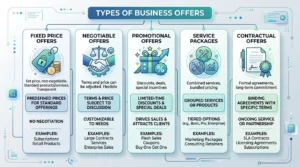
Fixed Price Offers
Fixed price ponude provide a clear and non-negotiable cost. Companies use them when services or products have stable pricing. As a result, customers can quickly make decisions without complex negotiations.
Negotiable Offers
Unlike fixed pricing, negotiable offers allow flexibility. Businesses often use them in B2B environments where contract size and scope vary. This flexibility improves deal-making and supports long-term partnerships.
Promotional Offers
Promotional offers aim to attract attention and increase sales within a limited timeframe. Companies often apply discounts, seasonal deals, or special bundles to encourage faster decisions.
Service-Based Offers
Service-based offers combine multiple services into one package. Agencies, consultants, and digital service providers frequently use this model to simplify pricing and increase perceived value.
Contractual Offers
Contractual ponude define formal business agreements. These offers include legal terms and conditions, which both parties must accept before execution. Overall, these categories show how business offer types adapt to different market needs and transaction styles.
How Business Offers Work in Real Transactions
The process of using ponude in business transactions follows a clear and structured flow. First, a company creates an offer based on internal pricing strategy and market research. This step ensures that the offer aligns with customer demand. Next, the company presents the ponuda to a potential client. At this stage, the client evaluates the offer by comparing it with other options in the market. Because competition is strong in most industries, comparison plays a crucial role in decision-making.
After evaluation, the client may accept the offer or request changes. During negotiation, both sides adjust pricing, scope, or conditions until they reach mutual agreement. Once both parties agree, the offer becomes a formal contract. This process demonstrates how business deal structures rely heavily on well-designed offers. Without structured ponude, negotiations often become unclear and inefficient.
Psychological Factors Behind Effective Business Offers
Psychology strongly influences how customers respond to ponude. Companies that understand buyer behavior often create more effective offers and achieve higher conversion rates. To begin with, perceived value plays a major role. Customers do not evaluate offers based only on price. Instead, they assess what benefits they receive in return. Therefore, companies focus on highlighting value rather than features.
Moreover, urgency increases decision speed. When businesses introduce limited time ponude, customers tend to act faster because they fear missing an opportunity. This principle is widely used in promotional campaigns.
In addition, anchoring shapes price perception. When customers see a higher reference price first, they often perceive subsequent offers as more affordable. As a result, businesses use strategic pricing presentation to influence decisions. These psychological techniques form the foundation of business negotiation psychology and modern pricing strategies.
Industry-Specific Ponude Examples
Different industries apply ponude in unique ways depending on their business models. For example, SaaS companies use subscription-based ponude that include tiered pricing and feature access levels. Meanwhile, e-commerce businesses rely on discounts, flash sales, and bundle offers to increase conversions.

In real estate, понуде often appear as property pricing negotiations where buyers and sellers adjust values based on market conditions. Similarly, digital marketing agencies use structured service packages to present clear pricing and deliverables. These examples demonstrate how service offers examples vary across industries while still following the same core principle of value exchange.
How Companies Structure High Converting Ponude
Successful companies design ponude with conversion optimization in mind. Instead of simply listing prices, they build structured offers that guide customer decisions. One common strategy involves tiered pricing. Businesses create multiple packages, such as basic, standard, and premium, to influence customer choice. Typically, customers select the middle option because it balances cost and value effectively.
Another effective method is value stacking. Companies combine multiple benefits into a single offer to increase perceived value. As a result, customers feel they receive more for their investment. Furthermore, clear messaging improves understanding. When companies focus on benefits instead of technical features, customers process information more easily and respond faster. These approaches strengthen business offer strategies and improve overall conversion performance.
Common Mistakes in Business Offers
Even experienced companies make mistakes when designing ponude. One frequent issue involves unclear communication. When an offer lacks clarity, customers struggle to understand its value, which reduces engagement. Another common problem is poor pricing justification. If companies do not explain why a price is set at a certain level, customers often perceive it as too high.
Additionally, weak differentiation reduces competitiveness. If a ponuda looks similar to others in the market, customers have no reason to choose it over alternatives. Therefore, businesses must clearly highlight unique advantages. Avoiding these mistakes significantly improves the effectiveness of commercial offers in competitive environments.
How to Compare Different понуде Effectively
Comparing понуде requires a structured approach rather than simple price comparison. Businesses should evaluate offers based on value, features, and long-term benefits. To make better decisions, companies often use comparison matrices. These tools help visualize differences between multiple offers and identify the most cost-effective option.
In addition, return on investment analysis provides deeper insight. Instead of focusing only on cost, businesses examine the potential value gained from each offer. This approach leads to smarter financial decisions. As a result, structured comparison improves understanding of commercial offer structures and supports better negotiation outcomes.
Digital Marketing Role in Promoting Ponude
Digital marketing plays a critical role in increasing the visibility of ponude. Businesses use SEO optimized landing pages to attract users searching for pricing information or service offers. At the same time, paid advertising campaigns help promote promotional ponude to targeted audiences. These campaigns increase reach and generate quick traffic.

Furthermore, conversion funnels guide users through the decision-making process. From awareness to final purchase, each stage is optimized to improve engagement and conversion rates. These methods are essential for scaling marketing offers and strengthening lead generation strategies.
FAQs
What are понуде in business?
Ponude are structured offers used to define pricing, services, or agreements between businesses and customers.
How do companies create ponude?
Companies design ponude by analyzing market demand, customer needs, and competitor pricing strategies.
Are понуде legally binding?
Some ponude become legally binding once both parties accept the terms and conditions.
What is the purpose of понуде?
The purpose is to communicate value clearly and establish terms for a business transaction.
Conclusion
Understanding понуде is essential for success in modern business environments. These offers influence pricing, negotiation, and overall value communication between companies and clients. When businesses design effective ponude, they improve decision-making speed, increase customer trust, and enhance conversion rates. Moreover, strong offer structures create a competitive advantage in crowded markets.
Ultimately, companies that optimize their ponude strategy achieve better performance, stronger positioning, and higher long-term profitability.