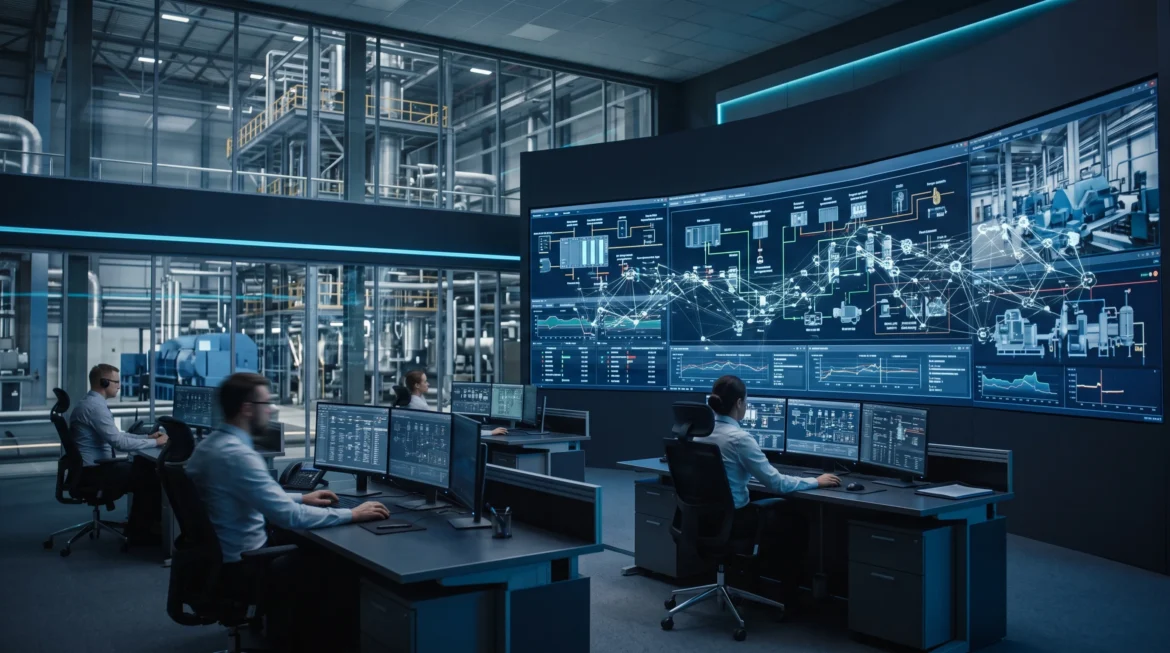
Modern critical infrastructure depends on digital systems that bridge software logic with physical hardware. In industrial automation, aicot represents an emerging artificial intelligence cyber defense approach designed specifically for Operational Technology. Funded through the European Union Digital Europe Programme under grant agreement 101249826, the aicot initiative addresses the growing need to safeguard physical processes against sophisticated intrusions without disrupting uptime.
The acronym also appears within clean energy engineering. OMRON Corporation developed a proprietary Anti-Islanding Control Technology under the name aicot to prevent hazardous backfeeding in clustered solar photovoltaic installations. This comprehensive guide covers both dimensions, focusing primarily on industrial cyber defense while detailing the engineering principles of solar grid stability.
Core Focus: Protecting Operational Technology and Critical Infrastructure
Operational Technology encompasses the physical controllers, actuators, sensors, and human interfaces that run essential services. Unlike traditional information technology networks that handle email, databases, and enterprise applications, OT environments manage physical realities such as water pressure, electrical voltage, rail signaling, and chemical mixing.
Historically, industrial sites maintained an air-gap, keeping operational machinery physically separated from external connections. The expansion of cloud analytics, remote vendor maintenance, and industrial IoT has dissolved that boundary. Connecting legacy control hardware to corporate enterprise networks has exposed critical infrastructure protection to severe digital threats. Because standard commercial endpoint protection tools cannot protect these environments, implementing an aicot framework provides the deep visibility needed where legacy programmable logic controllers lack the processing overhead to run heavyweight agents.
Mapping Defenses to the Purdue Model Architecture
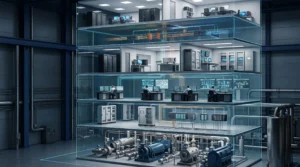
To understand where advanced operational technology security operates, security engineers refer to the Purdue Enterprise Reference Architecture, formalized under the ISA-95 standard. This framework divides industrial networks into distinct operational zones:
-
Level 0 (Physical Process): The physical equipment, including pumps, valves, conveyor belts, and sensors.
-
Level 1 (Basic Control): Programmable logic controllers (PLCs) and distributed control system (DCS) nodes that directly read physical process data and issue mechanical actuation commands.
-
Level 2 (Area Supervisory Control): Human Machine Interfaces (HMIs) and supervisory control and data acquisition (SCADA) software used by plant operators.
-
Level 3 (Site Operations): Manufacturing execution systems, batch management servers, and local plant historians.
-
Level 3.5 (Industrial DMZ): The critical buffer zone separating plant operations from corporate enterprise IT networks.
Deploying aicot tools inside Level 2 and Level 3 networks relies on non-intrusive monitoring appliances connected via network TAP or SPAN mirror ports. This architecture ensures that aicot inspects traffic moving across lower layers without injecting latency, allowing sensitive controllers to continue operating without interruption.
How the AI Engine Works: Protocol Inspection and Anomaly Detection
Industrial facilities run on specialized communication protocols rather than standard web traffic. Machine controllers speak languages such as Modbus TCP, DNP3, PROFINET, and IEC 61850. Because many of these protocols were designed decades ago without encryption or native authentication, an attacker with network access can send valid engineering commands that disrupt physical operations.
This is where anomaly detection in aicot systems delivers measurable security value. Rather than depending on static antivirus signatures, machine learning models continuously analyze network packets and industrial payload values. The aicot architecture establishes a deterministic behavioral baseline during normal facility operation, learning:
-
Standard communication intervals between specific operator workstations and field PLCs.
-
Allowable registers and safe threshold ranges for physical variables such as temperature, pressure, and flow rates.
-
Authorized maintenance windows for firmware updates and logic configuration rewrites.
When an abnormal sequence occurs, such as a controller receiving an unauthorized write request outside operating hours, machine learning algorithms identify the variance immediately. Incorporating adversarial AI and generative modeling allows aicot to recognize novel zero-day exploits designed to bypass perimeter defenses.
Trust and Threat Sharing: Decentralized Intelligence and SIEM Integration
Coordinated defense across national critical infrastructure requires timely intelligence sharing among energy producers, water authorities, and transit systems. However, infrastructure operators hesitate to share incident telemetry openly due to confidentiality obligations, proprietary operational data, and regulatory liabilities.
To resolve this bottleneck, aicot supports permissioned, privacy-preserving blockchain networks to exchange Cyber Threat Intelligence (CTI). By hashing and anonymizing threat indicators before distribution, competing utility providers can review confirmed indicators of compromise without exposing internal network topologies.
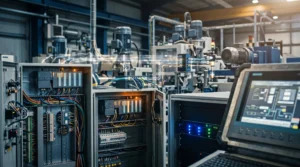
Additionally, telemetry flows directly into central Security Information and Event Management (SIEM) systems. The integration between aicot and SIEM platforms correlates OT protocol inspection alerts with broader enterprise IT event logs, giving Security Operations Center analysts contextual visibility across both business and industrial networks.
Industrial Incident Walkthrough: Detecting a Stealth Cyber Attack
Understanding how an intelligent operational framework mitigates real threats is best observed through a multi-stage intrusion scenario:
-
Initial Infiltration: An attacker compromises corporate IT credentials through phishing, gaining access to the enterprise network at Level 4.
-
Pivoting Across the DMZ: The adversary exploits a vulnerable remote-access jump host located within the Level 3.5 industrial DMZ to enter the plant network.
-
Internal Reconnaissance: Instead of generating high-volume network scans that trip basic alarms, the intruder silently sniffs Modbus traffic between a supervisory workstation and safety controllers.
-
Malicious Parameter Tampering: The adversary injects modified register commands intended to raise boiler pressure past safety thresholds while sending spoofed, normal readings back to the operator dashboard.
-
Algorithmic Detection and Isolation: The behavioral baseline identifies the irregular command structure, flagging a mismatch between the controller instruction and physical sensor feedback. An aicot alert routes through the SIEM platform, enabling human operators to isolate the compromised jump host before physical safety valves are forced open.
Operational Realities: False Positives, Explainability, and Legacy Equipment
Deploying artificial intelligence inside industrial networks presents distinct engineering challenges. In an office setting, a false positive might temporarily block an email or flag a clean file. In a power station or chemical refinery, an inaccurate security trigger that halts machinery can cause millions of dollars in equipment damage and disrupt regional power supplies.
To address this challenge, every operational aicot deployment emphasizes Explainable AI (XAI). Security operators cannot act on opaque confidence scores. The analytical engine must present transparent operational context, detailing exactly which protocol register changed, which device initiated the command, and how the value deviates from historic operational baselines. This technical context allows plant engineers to distinguish between an actual cyber attack and routine equipment calibration.
Furthermore, machine learning models must adapt to legacy devices that have operated continuously for fifteen or twenty years. Algorithms in aicot platforms must account for maintenance cycles, seasonal load variations, and planned retooling without requiring frequent retuning or generating excessive alert noise.
Regulatory Standards: NIS 2, IEC 62443, and European Digital Sovereignty
Securing essential services is no longer merely an internal engineering best practice; it is a strict legal requirement. The European Union has significantly expanded oversight through the Network and Information Security (NIS 2) Directive, which imposes strict operational security mandates, rapid incident reporting rules, and heavy financial penalties on essential entities across energy, transport, health, and water sectors.
At the technical level, organizations structure their cyber defense around the IEC 62443 standard series, the internationally recognized benchmark for industrial automation and control systems security. Utilizing aicot helps industrial operators meet IEC 62443-3-3 system security requirements through continuous monitoring and behavioral visibility.
The emphasis on indigenous defense technology also advances European digital sovereignty. Backed by the EU Digital Europe Programme, the development of aicot strengthens domestic resilience by reducing reliance on external technology vendors and ensuring public utility operators maintain sovereign control over critical defense infrastructure.
Alternative Meaning: OMRON Solar Anti-Islanding Control Technology
While cybersecurity dominates recent technical discussions, aicot is also widely recognized in clean energy engineering as OMRON’s proprietary Anti-Islanding Control Technology. This electrical safety feature is integrated directly into photovoltaic power conditioners and solar inverters.

The Physics of Unintentional Islanding
When a localized electrical utility outage occurs, neighborhood power lines lose grid connection. However, if residential rooftop solar installations continue generating electricity during sunny conditions, they can maintain power along that isolated segment of the distribution network. This condition is known as unintentional islanding.
Unintentional islanding presents two severe hazards:
-
Lineworker Safety: Utility technicians sent to repair downed lines expect the circuit to be dead. Backfed current from local solar arrays creates severe electrocution risks.
-
Grid Equipment Damage: When the main utility grid reconnects, out-of-phase power can destroy home appliances, solar inverters, and distribution transformers.
Frequency Feedback with Reactive Power Step Injection
Traditional solar inverters use passive monitoring, watching for simple voltage or frequency deviations. When dozens of homes on the same street install solar panels, passive detection often fails because multiple inverters interact, canceling out subtle electrical shifts and masking utility outages.
OMRON solved this multi-unit interference issue by introducing the active aicot detection mechanism. The power conditioner constantly monitors grid frequency while introducing controlled, minute changes in reactive power. While the high-capacity utility grid remains connected, it stabilizes the local circuit, absorbing these micro-injections with negligible frequency variance.
If utility power fails, that stabilizing force disappears. The reactive power injection triggers an immediate, pronounced shift in grid frequency. The internal control logic detects this frequency response and disconnects the solar array within milliseconds.
Validation at Pal Town Josai-no-Mori
OMRON validated this technology through extensive multi-unit field trials at the Pal Town Josai-no-Mori residential project in Gunma Prefecture, Japan. The installation interconnected over 550 solar-equipped homes, delivering more than 2 megawatts of distributed capacity on a shared distribution line. Testing confirmed that inverters equipped with aicot successfully detected utility disruptions without interfering with neighboring systems, setting a benchmark for international grid codes including IEEE 1547 and UL 1741.
Comparing Industrial Defense with Traditional IT Security
Protecting industrial operations requires fundamentally different technical trade-offs than managing enterprise IT environments:
| Operational Dimension | Standard Enterprise IT Security | Industrial OT Cyber Defense |
| Primary Priority | Data confidentiality and access control | Operational safety, physical integrity, and process uptime |
| Telemetry Impact | Active endpoint scanning, routine software updates | Passive network analysis via mirror ports to avoid latency |
| Protocol Support | Standard web protocols (HTTP, TLS, DNS, SSH) | Industrial automation protocols (Modbus, DNP3, PROFINET, IEC 61850) |
| Component Lifecycle | 3 to 5 years (laptops, commercial servers) | 15 to 30 years (PLCs, turbines, field instruments) |
| Incident Consequence | Data leaks, financial exposure, system re-imaging | Equipment damage, environmental harm, physical injury |
FAQs
What does the acronym represent across different industries?
In operational cybersecurity, the term denotes artificial intelligence platforms built for critical infrastructure defense. In renewable power engineering, it refers to OMRON’s Anti-Islanding Control Technology used in solar inverters.
Does this industrial cybersecurity approach replace human operators?
No. Machine learning models in aicot analyze massive network telemetry to detect anomalous patterns and correlate alerts. Human security analysts and control room engineers make the final operational decisions regarding physical equipment mitigation.
Can passive network monitoring disrupt legacy PLCs?
Passive monitoring captures traffic through network TAP or mirror ports on industrial switches. Because no active query packets or diagnostic scans are sent directly to older field controllers, process uptime remains unaffected.
Why is anti-islanding protection essential for residential solar?
Anti-islanding prevents solar arrays from feeding live electrical current into local distribution grids during an outage, protecting line technicians from electrocution and preventing transformer damage during power restoration.
What funding supports the cybersecurity initiative?
The European research initiative is supported by the European Union Digital Europe Programme under grant agreement number 101249826, targeting technology readiness levels 7 through 8 for real-world pilot deployment.
Final Thoughts on Industrial Resilience
The ongoing convergence of physical production systems with digital networks demands specialized defenses. Whether safeguarding industrial controllers against sophisticated intrusions or stabilizing distributed solar generation across local utility grids, robust engineering remains vital. Understanding how modern aicot frameworks identify anomalous activity without causing physical interruptions provides organizations with the foundation needed to build resilient operational systems.