1. The Invisible Material Powering Modern Technology
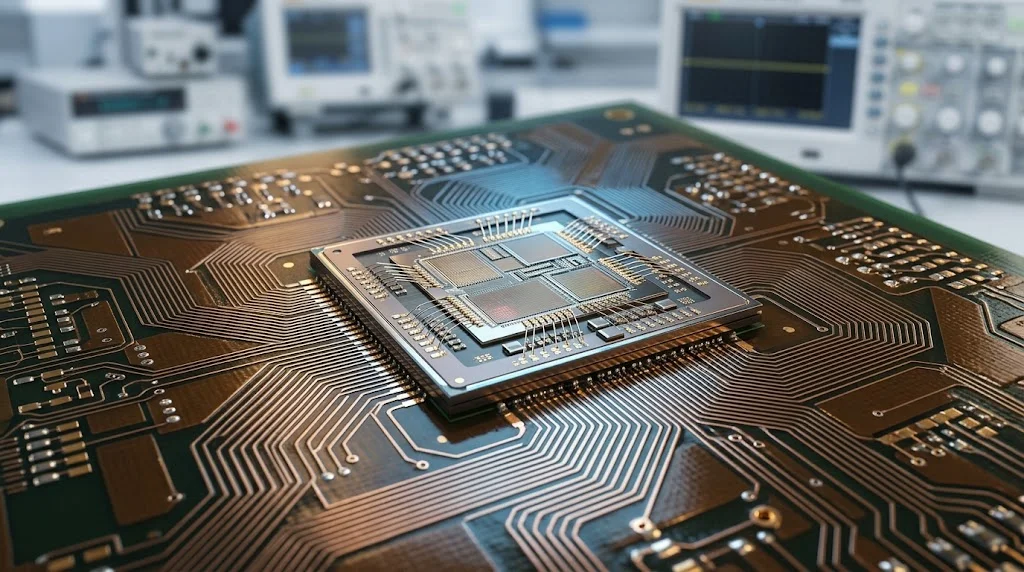
Every major milestone in consumer tech, artificial intelligence, and mobile computing depends on miniaturization. Silicon processors have shrunk to single-digit nanometer nodes, cramming billions of transistors onto tiny dies. However, powerful silicon cannot function in isolation. It requires an advanced packaging bridge to connect microscopic chip terminals to macroscopic printed circuit boards without overheating, warping, or distorting high-speed signals. In modern computer hardware and consumer electronics, bismaleimide triazine serves as the unsung structural foundation making these computing leaps possible.
To understand its role in tech hardware, engineers and tech analysts distinguish between several developmental stages of the material:
-
BT Resin: The raw chemical polymer blend combining bismaleimide and cyanate ester chemistry.
-
BT Epoxy: The modified resin system blended with specialty epoxies to increase flexibility, improve resin flow, and boost mechanical toughness during electronics fabrication.
-
BT Prepreg: Woven glass cloth pre-impregnated with uncured resin, stored in an intermediate state ready for pressing.
-
BT Laminate: The fully cured, copper-clad sheet material used as a building block for multi-layer hardware architectures.
-
BT Substrate: The finished, micro-routed packaging foundation that holds the silicon die inside smartphones, memory modules, and high-frequency communication chips.
2. Polymer Chemistry: Why Silicon Needs This Specialized Thermoset
Silicon is an unforgiving material in tech hardware design. When high-performance chips run computational workloads, they generate substantial heat. If the substrate beneath the chip expands too quickly or softens under thermal stress, micro-connections shear off and the device fails.
The durability of bismaleimide triazine comes directly from its molecular architecture. The material is synthesized from two primary chemical precursors: bismaleimide monomers containing reactive maleimide end groups and cyanate ester monomers derived from bisphenol structures.
When heated during manufacturing, these components undergo a dual curing reaction:
-
Cyanate ester monomers cyclotrimerize to create planar, symmetrical six-membered triazine rings.
-
Bismaleimide double bonds undergo addition crosslinking.
-
The maleimide units and cyanate networks covalently lock together, producing a rigid three-dimensional thermoset structure.
This crosslinked structure prevents polymer chains from shifting under thermal cycling. To ensure the finished material can withstand drop impacts and mechanical vibration in mobile devices, chemical formulators blend in controlled amounts of modified polyphenylene ether (PPE) and epoxy resins, achieving an ideal balance of hardness and fracture toughness.
3. Core Technical Properties Behind Modern Device Reliability
To meet the strict power and speed standards of next-gen electronics, materials must meet exact physical, thermal, and electrical metrics.
Elevated Thermal Thresholds
Standard electronics traditionally relied on FR-4 laminates with glass transition temperatures between 130°C and 170°C. In contrast, bismaleimide triazine exhibits a glass transition temperature ranging from 180°C to over 240°C, alongside thermal decomposition thresholds exceeding 350°C. This extreme heat tolerance ensures that dense multi-layer boards remain mechanically stable during lead-free soldering and intense processor overclocking.
Thermal Expansion Matching and Warpage Control
Silicon dies expand at roughly 3 to 3.5 ppm/°C. Standard circuit boards expand at 14 to 18 ppm/°C in their X and Y directions. When heat surges through a device, this thermal expansion mismatch causes package warpage, leading to solder-ball fractures.
By combining the polymer with microscopic silica filler particles and precision T-glass fabric, engineers lower the in-plane coefficient of thermal expansion down to 10 to 15 ppm/°C. Restricting expansion along the vertical Z-axis protects microscopic through-holes and blind vias from fatigue failure.
Signal Integrity at High Frequencies
As telecommunications shift into higher frequency bands, signal loss becomes a serious bottleneck. The non-polar molecular framework of bismaleimide triazine yields a low dielectric constant between 2.8 and 3.7 at 1 GHz, with an electrical dissipation factor below 0.008. These values remain stable across wide temperature and humidity swings, allowing clean high-frequency transmission in millimeter-wave antennas and multi-gigabit memory buses.
Humidity Resistance and CAF Prevention
Moisture inside an electronic device degrades dielectric consistency and can cause short circuits. BT formulations absorb less than 0.2% moisture by weight after a full day of immersion. This moisture resistance, combined with excellent polymer adhesion to glass fibers, prevents conductive anodic filament (CAF) formation, shielding circuits from copper migration under sustained voltage bias.
4. Real-World Applications Across the Tech Industry
From enterprise data centers to pocket devices, bismaleimide triazine is embedded across several core technology sectors.
Mobile Devices and Wearables
Smartphones and smartwatches require microscopic form factors. Ball Grid Array (BGA) and Chip-Scale Package (CSP) designs utilize ultra-thin BT substrates as thin as 100 microns. The material keeps these thin layers flat, ensuring solder ball coplanarity across thousands of micro-connections during high-speed automated assembly.

Flash Storage and System Memory
High-capacity solid-state drives (SSDs) and smartphone storage depend on vertically stacked NAND flash dies. These stacks use BT laminates as internal packaging carriers. The material easily withstands the cumulative heat generated by continuous read-write cycles in mobile memory chips and desktop DDR5 memory modules.
5G mmWave and Automotive Radar
Autonomous driving sensors and 5G communication systems operate at high frequencies. Automotive 77 GHz radar modules and 5G antenna-in-package (AiP) arrays specify this material family because its low signal absorption extends radar detection ranges and keeps wireless data streams crisp.
Multi-Die Chiplets and AI Hardware
As modern AI processors move away from single monolithic chips toward modular chiplet architectures, structural stability is paramount. Multi-layer BT substrates act as rigid organic carrier platforms beneath silicon interposers and bridge dies, absorbing thermal stress between different chip sections.
5. Material Comparison: BT Resin vs. FR-4 vs. ABF
Hardware architects balance material characteristics against production costs to choose the best substrate for each product tier.
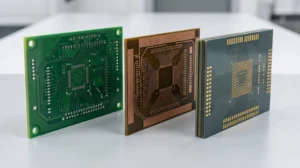
Standard FR-4 remains the workhorse for conventional computer motherboards, display control boards, and consumer power supplies where trace spacing is wide and operating temperatures remain moderate.
Meanwhile, BT resin and ABF film often work together inside high-end processors. Modern computing packages frequently employ a reinforced, rigid core made of bismaleimide triazine at the center of the stackup for structural rigidity, while unreinforced ABF layers are laminated on top to route ultra-dense micro-traces directly under the CPU or GPU die.
6. Hardware Manufacturing and Processing Dynamics
Turning advanced resin into working circuit boards requires specialized manufacturing methods.
Microvia Formation and Laser Machining
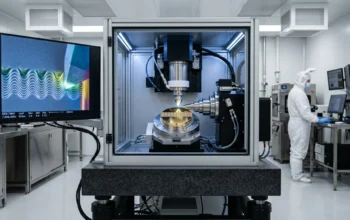
Mechanical drilling struggles on miniature packaging substrates where via holes measure less than 100 microns across. Because cured BT matrices are extremely hard and contain abrasive silica fillers, mechanical drill bits suffer quick tip wear. Hardware fabricators turn to UV and CO2 laser ablation to vaporize dielectric layers cleanly. Downstream, automated plasma cleaning systems remove organic residue to prepare clean via sidewalls for copper plating.
Ultra-Fine Traces via mSAP Processing
Standard subtractive chemical etching cannot create the sub-20-micron line-and-space routing required by modern microchips. Fabricators use the modified semi-additive process (mSAP) over thin BT laminates. Very low profile (VLP) or reverse-treated copper foils are laminated onto the core to provide a smooth, uniform surface that enables precise chemical plating without trace undercut.
7. SMT Assembly and Industry Reliability Standards
After fabrication, substrates face demanding thermal tests on surface-mount assembly lines.
Lead-Free SMT Reflow Resilience
Modern environmental regulations require lead-free solder pastes that melt at peak temperatures between 255°C and 260°C. While standard materials can blister or delaminate under repeated thermal exposure, bismaleimide triazine withstands multiple consecutive reflow cycles without internal cracking. This resilience allows double-sided board assembly and component rework without damaging the board.
Moisture Ratings and Popcorning Elimination
If moisture seeps into a circuit board, it can flash into steam during reflow soldering, causing internal layers to explode apart in a failure mode called popcorning. Because BT substrates exhibit minimal water absorption, they easily earn Moisture Sensitivity Level 1 (MSL 1) and Level 2 ratings under JEDEC J-STD-020 standards, giving tech manufacturers long floor-life windows during production runs.
Dynamic Warpage Compliance
Under the JEDEC JESD22-B112 standard, automated shadow moiré optical tools track board flatness as components pass through reflow heat zones. The high flexural modulus of the cured resin system keeps warpage within acceptable limits, guaranteeing that every solder joint on high-pin-count chips bonds securely.
8. Commercial Supply Chain and Sourcing Landscape
Specifying packaging materials requires choosing qualified commercial grades and managing supply lines carefully.
Industry Leaders and Material Grades
-
Mitsubishi Gas Chemical (MGC): The original developer of this material chemistry. The MGC HL832NX and HL830 product lines remain the global benchmarks for memory chips and fine-pitch BGA substrates.
-
AGC Nelco: Provides the established N5000 series, widely adopted in telecommunications infrastructure and defense-grade electronics for its thermal resilience and low dielectric loss.
-
Doosan Corporation: Manufactures specialized low-loss laminates designed for mobile devices, high-density packaging, and networking hardware.
Sourcing Strategy and RFQ Best Practices
Because primary synthesis of bismaleimide triazine is concentrated among a few specialized chemical manufacturers, hardware designers must manage supply chain single-source risks. Sourcing teams frequently dual-qualify secondary grades from AGC Nelco or Doosan alongside primary MGC baselines to ensure steady production during component shortages.
When engineering teams draft Request for Quotation (RFQ) packages, they should specify exact technical parameters rather than generic material terms:
-
Explicit commercial resin grade and manufacturer name
-
Dielectric core thickness, copper weight, and copper foil profile
-
Glass style and resin content ratio
-
Target Dk and Df tolerances at specified operating frequencies
-
Applicable IPC-4101 slash sheet standards
-
Maximum allowable dynamic warpage tolerances per JEDEC guidelines
By setting these detailed requirements early, tech hardware companies ensure their packaging substrates deliver the thermal durability, dimensional precision, and high-frequency stability demanded by modern computing devices.