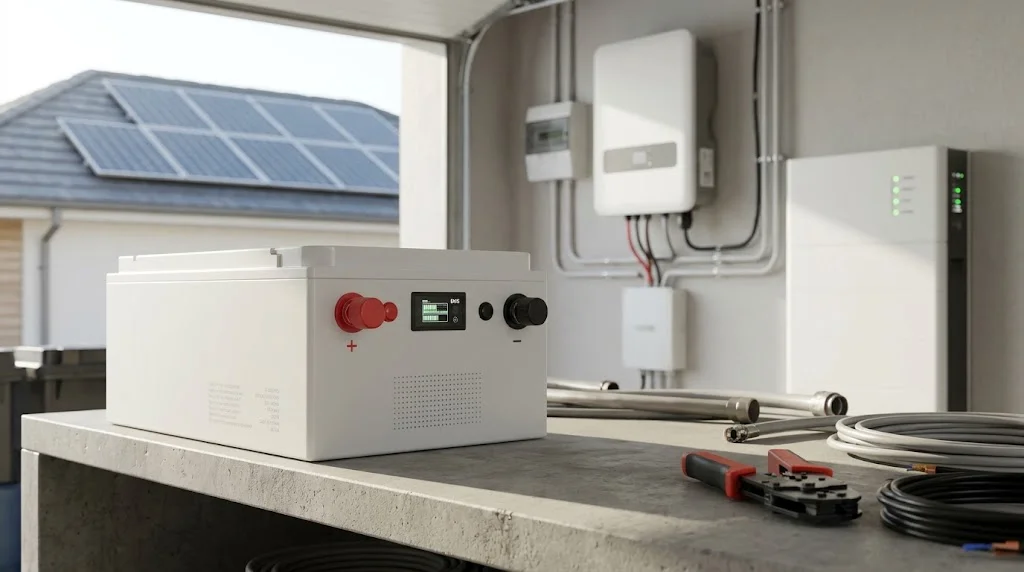
Energy storage has undergone a rapid shift over the past decade. If you have spent time researching off-grid solar kits, upgrading a campervan electrical setup, or shopping for reliable home backup, you have almost certainly encountered lifepo4 lfp batteries.
These power sources have steadily displaced older battery chemistries, earning a reputation as the workhorses of renewable energy. They provide a rare combination of exceptional longevity, stable chemistry, and low maintenance. This comprehensive guide walks through the science behind this chemistry, examines its real-world performance, and provides the technical specifications needed to configure an efficient power setup.
What Is a LiFePO4 Battery and Are LFP and LiFePO4 the Same?
One of the most common points of confusion for newcomers is the overlapping acronyms. The simple answer is yes: LiFePO4 and LFP refer to the exact same battery technology.
LiFePO4 represents the chemical formula for Lithium Iron Phosphate, detailing the lithium cations, iron center, and phosphate tetrahedral framework. LFP serves as the industry abbreviation derived from the Latin term for iron, ferrum. Both terms describe an advanced family of lithium-ion technology known for safety and durability. Understanding lifepo4 lfp batteries starts with looking closely at their crystal structure and material composition.
Demystifying the Chemistry and Industry Terminology
Unlike consumer electronics batteries that rely on nickel, cobalt, or manganese oxides, these cells use an iron phosphate cathode paired with a graphitic carbon anode on a copper foil substrate. The strong covalent bonds connecting the phosphorus and oxygen atoms inside the phosphate group form a stable olivine crystal lattice. This robust chemical framework gives the cells distinct physical characteristics, preventing structural degradation even after thousands of charge and discharge cycles.
Basic Working Principle: Anode, Cathode, and the Reversible Redox Cycle
During the charging cycle, an external power source creates an electric potential that forces lithium ions to release from the iron phosphate cathode. These ions travel through a conductive organic electrolyte, pass through a microporous polyolefin separator, and intercalate into the layered graphite anode. At the same time, electrons travel through the external circuit to maintain charge neutrality.
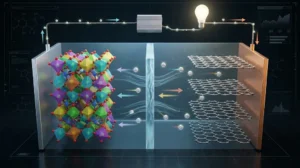
When you connect an appliance, such as an inverter running an off-grid cabin, the process reverses smoothly. The lithium ions de-intercalate from the graphite anode, pass back across the liquid electrolyte, and dock back into the cathode framework, delivering continuous electric current.
Core Advantages: Why Modern Energy Systems Rely on LFP Chemistry
The widespread adoption of lifepo4 lfp batteries across residential and commercial installations is driven by measurable engineering benefits over legacy chemistries.
+-------------------------------------------------------------------+
|               KEY ADVANTAGES OF LiFePO4 / LFP CELLS               |
+-------------------------------------------------------------------+
|  1. Superior Longevity    | 3,000 to 5,000+ full cycles           |
|  2. Unrivaled Safety      | Resists thermal runaway up to ~270°C  |
|  3. Flat Voltage Profile  | Stable 12.8V - 13.2V output           |
|  4. Full Usable Capacity  | 100% Depth of Discharge with no harm  |
|  5. Ethical Materials     | 100% free from mined cobalt or nickel |
+-------------------------------------------------------------------+
Exceptional Cycle Life and Usable Lifespan
Traditional flooded lead-acid and absorbed glass mat (AGM) units typically last between 300 and 600 charge cycles before their internal plates break down. Standard nickel-based lithium cells yield around 500 to 1,000 cycles.
In comparison, quality iron phosphate cells reliably deliver 3,000 to 5,000 full charge cycles at an 80 percent depth of discharge (DoD). Even when discharged completely down to zero percent, a well-managed cell can easily achieve 2,500 cycles before its maximum capacity drops to 80 percent of its factory rating. For everyday users cycling their setup daily, this equates to 10 to 15 years of uninterrupted service.
Inherent Fire Safety and Thermal Stability
Safety is the standout advantage of this chemistry. Conventional cobalt-based lithium cells (such as NMC and NCA) run the risk of thermal runaway if punctured, shorted, or overcharged. When those oxides overheat, their chemical bonds release free oxygen gas, fueling intense fires that generate their own oxidizer.
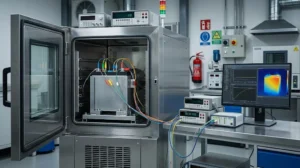
The phosphorus-oxygen bond in an iron phosphate cathode is far stronger. It requires temperatures above 270°C (518°F) before any thermal breakdown begins, compared to roughly 150°C to 210°C for nickel-cobalt designs. Because it resists oxygen release, it will not support runaway combustion, making it safe for living areas, cabins, and vehicle cabins.
Consistent Voltage Delivery and True Depth of Discharge
Lead-acid systems experience significant voltage sag under load, causing inverters to shut down prematurely while usable power remains trapped in the bank. Furthermore, pulling a lead-acid unit below 50 percent capacity causes severe plate sulfation that cuts its service life in half.
Iron phosphate delivers a nearly flat discharge curve. A 12-volt nominal pack stays between 13.2 volts and 12.8 volts across almost 90 percent of its discharge cycle, ensuring connected electronics receive clean, stable power. In addition, you can tap into the full 100 percent capacity without damaging cell health, giving you roughly double the usable energy of a lead-acid battery with an identical ampere-hour rating.
Clean, Cobalt-Free Raw Materials
The extraction of cobalt and nickel comes with severe environmental costs and supply chain vulnerabilities. Iron and phosphate are abundant, non-toxic, and simple to source responsibly. Choosing equipment built around these elements eliminates reliance on hazardous heavy metals, simplifies recycling workflows, and avoids the toxic off-gassing associated with flooded lead-acid alternatives.
Honest Engineering Limitations and Trade-Offs
While the strengths are clear, no single battery technology fits every single scenario. A balanced evaluation requires looking at the limitations.
Volumetric Energy Density Comparisons
The main compromise with this chemistry is gravimetric and volumetric energy density. Iron phosphate packs carry an energy density between 90 and 160 watt-hours per kilogram, compared to 150 to 250 watt-hours per kilogram for nickel-manganese-cobalt chemistries.
Because NMC stores more energy in a smaller and lighter profile, it remains the standard choice for smartphones, ultra-thin laptops, and long-range electric sports cars where space is tight. However, for stationary solar storage, RV house banks, marine systems, and portable power stations, this slight weight penalty is easily offset by the superior lifespan and safety.
Upfront Purchase Investment vs Long-Term Value
The initial purchase price of lifepo4 lfp batteries is higher than traditional AGM or flooded batteries. A reliable 12V 100Ah lithium unit often costs twice as much up front as an entry-level lead-acid option.
However, looking at the levelized cost of storage (LCOS) tells a completely different financial story. Because an iron phosphate unit lasts through ten times the cycles while delivering twice the usable power per cycle, the actual cost per kilowatt-hour stored and delivered over its lifespan is roughly a third of lead-acid. The higher upfront cost is an investment that yields significant dividends over a decade of use.
Cold-Weather Operations:
Cold weather behavior is an essential detail that generic guides often skip. There is a fundamental difference between discharging an iron phosphate battery in freezing temperatures and attempting to recharge it.
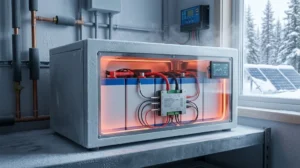
The Threat of Lithium Plating Below Freezing
You can safely pull power from an iron phosphate battery down to -20°C (-4°F). The internal impedance rises, which causes a temporary dip in capacity, but discharging does not harm the cell structure.
Charging below 0°C (32°F) is another matter entirely. At freezing temperatures, the diffusion rate of lithium ions slows significantly. When a charge current is forced through the cell, the ions cannot insert themselves between the graphite layers of the anode quickly enough.
Instead, they accumulate on the graphite surface as metallic lithium. This reaction, known as lithium plating, causes irreversible capacity loss, raises internal resistance, and can grow sharp microscopic dendrites that puncture the separator, creating an internal short circuit.
How Internal Heating Elements and Smart BMS Sensors Protect Cells
To prevent this issue, high-grade batteries include integrated low-temperature charging protection within their management circuitry. When temperature probes register conditions below freezing, the system disconnects the charging path while allowing normal discharge to continue.
For winter overlanding, unheated cabins, and cold marine applications, modern units feature integrated internal heating elements. When incoming solar or AC current is detected in sub-freezing weather, the system routes power to thin internal heating pads first. Once the core temperature rises safely above 5°C (41°F), the circuit directs current to the cells, ensuring safe charging without human intervention.
The Critical Role of the Battery Management System (BMS)
An iron phosphate cell should never be operated without a dedicated battery management system. The BMS functions as the operational brain, continuously monitoring cell voltages, pack temperatures, and current flow to keep the battery within safe operating thresholds.
Active vs Passive Cell Balancing
A standard 12.8V pack contains four individual 3.2V cells connected in series. Over hundreds of cycles, subtle manufacturing variances cause individual cells to charge and discharge at slightly different rates. If one cell hits its high-voltage limit before the others, the BMS must shut down the charge cycle, preventing the remaining cells from filling completely.
-
Passive Balancing: Most standard commercial packs use passive balancing. When a cell exceeds a preset voltage threshold during the final charging stage, the system bleeds off excess energy as heat through small resistors until the other cells catch up. This method is cost-effective, simple, and reliable for small to medium battery banks.
-
Active Balancing: Advanced and high-capacity banks use active balancing circuitry. Rather than wasting energy as heat, active balancers use inductive or capacitive circuits to shuttle charge from higher-voltage cells into lower-voltage cells. This process equalizes the pack efficiently with minimal thermal buildup, making it ideal for large residential and commercial banks.
Dealing with State-of-Charge Drift Along a Flat Voltage Curve
Because the discharge curve is exceptionally flat, measuring voltage with a basic voltmeter will not give you an accurate gauge of remaining capacity. A reading of 13.1 volts could indicate an 80 percent charge level or a 30 percent charge level depending on recent loads and resting times.
High-performance setups rely on a precision shunt-based monitor or a smart BMS with integrated Bluetooth telemetry. These systems monitor current entering and leaving the pack over time, calculating remaining capacity through Coulomb counting rather than resting voltage alone.
Chemistry Face-Off: LiFePO4 vs Traditional Lithium-Ion vs Lead-Acid
Choosing the right storage technology requires an objective look at key specifications. The table below compares the primary options available for modern energy storage.
| Performance Metric | LiFePO4 (LFP) | Lithium-Ion (NMC) | Lead-Acid (AGM / Flooded) |
| Cycle Life (@ 80% DoD) | 3,000 to 5,000+ cycles | 500 to 1,000 cycles | 300 to 500 cycles |
| Usable Depth of Discharge | 100% (80-90% optimal) | 80% | 50% max recommended |
| Thermal Runaway Threshold | ~270°C (518°F) | ~150°C to 210°C | Low fire risk; outgasses $H_2$ |
| Gravimetric Energy Density | 90 to 160 Wh/kg | 150 to 250 Wh/kg | 30 to 50 Wh/kg |
| Toxicity & Cobalt Content | Completely cobalt-free | Contains cobalt & nickel | Heavy lead & sulfuric acid |
| Maintenance Requirements | Zero maintenance | Zero maintenance | Terminal cleaning & watering |
| Round-Trip Efficiency | 95% to 98% | 94% to 97% | 75% to 85% |
| Levelized Cost per Cycle | Lowest over lifespan | Moderate | High due to replacements |
This clear performance advantage explains why builders and installers rely on lifepo4 lfp batteries for demanding off-grid power systems.
Upgrading from Lead-Acid: Drop-In Replacement Reality Check
Many manufacturers market their products as drop-in replacements for traditional Group 24, 27, or 31 lead-acid cases. While they fit into the same physical battery trays, swapping chemistries requires attention to your electrical architecture.
Alternator Protection and the Need for DC-to-DC Chargers
A standard lead-acid battery has high internal resistance. As it charges, this resistance slows current acceptance, protecting the vehicle alternator from overworking.
Iron phosphate has exceptionally low internal resistance. It accepts high current as fast as the charging source can supply it. If you connect a depleted lithium house bank directly to a standard vehicle alternator via a simple mechanical isolator relay, the battery will pull maximum current continuously. At low engine RPMs, where the alternator cooling fan spins slowly, this sustained draw can overheat and burn out the alternator windings.
The correct solution is installing an isolated DC-to-DC smart charger between the starter battery and the lithium bank. A DC-to-DC charger regulates current flow to a safe level, protects the alternator, and supplies the precise multi-stage charging profile lithium cells need.
Correct Charge Controller Profiles: Bulk, Absorption, and Float Voltages
Older battery chargers and legacy solar charge controllers often include automatic equalization modes designed to boil electrolyte and remove lead sulfate crystals from lead plates. Applying high equalization voltages (often exceeding 15.5 volts) to lithium cells will instantly trigger the high-voltage disconnect on your BMS.
Lithium iron phosphate does not require long absorption periods because it absorbs charge efficiently all the way to 95 percent capacity. Once full, the charger should drop to a gentle float stage between 13.5V and 13.6V, avoiding unnecessary chemical stress.
Primary Applications: Where LiFePO4 Power Thrives
Thanks to their stability and deep-cycling capabilities, lifepo4 lfp batteries have become the primary choice across several demanding industries.
Off-Grid Solar Energy and Residential Backup
In a stationary solar setup, the battery bank is cycled almost every single day. Power generated during sunlight hours runs household loads and charges the bank, which then powers the home through the night.
In this application, cycle life is the single most important metric. Lead-acid banks often require total replacement every three to four years under daily cycling, creating high maintenance and replacement expenses. An iron phosphate bank easily handles daily cycling for a decade or more while providing 95 percent round-trip efficiency, ensuring you lose very little precious solar power to resistance losses.
Recreational Vehicles, Campervans, and Overlanding
Weight distribution and space optimization are critical when designing mobile living platforms. Replacing two 65-pound AGM batteries (providing 100Ah of usable power combined) with a single 100Ah lithium unit cuts battery weight from 130 pounds down to roughly 25 pounds, all while delivering identical runtime.
Furthermore, the fast charging rate of iron phosphate allows RV owners to fully recharge their systems during brief sunny windows or short drives between campsites.
Marine Systems and Trolling Motors
Bass boats, cruising catamarans, and commercial vessels benefit substantially from this technology. For electric trolling motors, the flat voltage discharge ensures that motor thrust remains consistent from the beginning of the day until the final cast. With lead-acid, thrust drops steadily as the bank discharges.
Additionally, sealed iron phosphate cases eliminate the risk of spilled sulfuric acid in the bilge, do not outgas explosive hydrogen during charging, and resist the vibration stresses common to marine environments.
Buyer Checklist: How to Choose Grade A Hardware
Not all battery packs available on the open market offer the same build quality. When sourcing lifepo4 lfp batteries, use the following checklist to evaluate hardware before purchasing:
-
Prismatic vs Cylindrical Cells: Large prismatic cells simplify pack construction by reducing the number of internal bolted or welded busbar connections. Cylindrical cells (such as 32650 or 26650 formats) are reliable for compact setups, but large-capacity banks benefit from heavy-duty prismatic cells.
-
Grade A Cell Certification: Verify that the manufacturer uses brand-new, factory-matched Grade A cells. Budget builders occasionally use Grade B or retired EV cells that show mismatched internal impedances and lower usable capacities.
-
Low-Temperature Cutoff Sensors: Never buy a battery intended for unconditioned spaces without confirming that the internal BMS features low-temperature charging disconnect protection.
-
BMS Continuous Discharge Current: Check the maximum continuous discharge current rating of the internal BMS. A 100Ah battery with a 50A BMS can only supply 640 watts of continuous load, which cannot run a standard 1,000-watt microwave or coffee maker. Look for a 1C rating (a 100A BMS on a 100Ah pack) whenever possible.
-
Manufacturer Warranty Terms: High-quality manufacturers stand behind their engineering with warranties spanning 5 to 11 years, backed by clear degradation parameters.
FAQs
Can I leave a LiFePO4 battery connected to a charger indefinitely?
Yes, provided the charger uses a dedicated lithium algorithm that drops to an appropriate float voltage (13.5V to 13.6V) or shuts off completely once absorption concludes. You should avoid float voltages above 13.8V for long periods, as keeping the cells pinned at absolute maximum saturation puts unnecessary stress on the internal chemistry.
What is the ideal storage level for long periods of inactivity?
If you are winterizing a boat or placing an RV into seasonal storage, disconnect all parasitic loads and store your lifepo4 lfp batteries at roughly 50 to 70 percent state of charge (around 13.2 volts). Store them in a cool, dry place. Thanks to their low self-discharge rate of 1 to 3 percent per month, they can sit safely for six months or longer without needing a top-up charge.
Do I need a specialized charger for these batteries?
Yes. While a standard lead-acid charger can supply temporary emergency current if its voltage does not exceed 14.6 volts, standard chargers lack the correct charge termination logic. They can remain stuck in high-voltage saturation modes or initiate desulfation pulses that damage the electronic BMS. Using a dedicated multi-stage lithium charger or a programmable MPPT solar controller ensures optimal lifespan and performance.
Can you connect these batteries in series and parallel?
Most modern units allow you to link up to four batteries in series (creating a 24V, 36V, or 48V bank) and up to four in parallel to expand ampere-hour storage. However, always review the manufacturer guidelines first. Mixing cells in series requires that all units start at identical voltage levels (within 0.05 volts) to prevent premature BMS cutoffs.
Why do some installations still use lead-acid?
Lead-acid remains common primarily due to low initial purchase cost and established supply chains for basic engine cranking. For non-critical backup applications that cycle only once or twice a year, the lower initial cost of lead-acid can be appealing. But for setups that demand frequent cycling, long service life, fast charging, and dependable safety, lifepo4 lfp batteries deliver superior long-term performance and value.